Natalie Nyathi
President Donald Trump is facing strong opposition from Democratic leaders as he seeks to expand the deployment of the National Guard to address crime and immigration in major U.S. cities. Recent threats to send troops to Baltimore, Maryland, and potential plans for Chicago have ignited a heated debate over federal authority and the role of the military in domestic law enforcement.
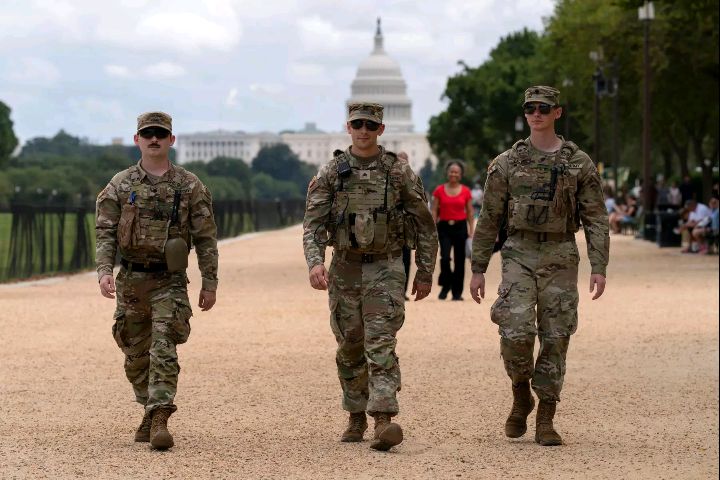
Trump has publicly criticized Baltimore as “out of control” and “crime-ridden,” mirroring his rhetoric about other Democratic-led cities. In response to an invitation from Maryland Governor Wes Moore to discuss public safety in Baltimore, Trump suggested he might instead “send in the ‘troops.” This echoes his earlier deployment of the National Guard in Washington, D.C., a move that has been widely criticized as an overreach of federal power.
Governor Moore has strongly rebuffed Trump’s characterization of Baltimore, highlighting the city’s progress in reducing crime. According to the Baltimore Police Department, homicides have decreased by 22% in 2025 compared to the previous year. Moore has also criticized Trump’s deployment of the National Guard in D.C. as “unconstitutional” and stated that he would not authorize the Maryland National Guard to be used in a similar manner.
The dispute has escalated into a personal feud, with Trump calling Moore “nasty” and even threatening to reconsider federal funding for the Francis Scott Key Bridge rebuild. Moore, in turn, has accused Trump of “spouting off a bunch of lies about public safety in Maryland” and alluded to the president’s medical deferment from the Vietnam War.
Reports indicate that the Trump administration is also considering deploying the National Guard to Chicago, the country’s third-largest city. The Pentagon has been developing plans for a potential deployment as early as September, citing concerns about crime, homelessness, and immigration.
However, Illinois Governor J.B. Pritzker and Chicago Mayor Brandon Johnson have both vehemently opposed the idea. Pritzker has accused Trump of “attempting to manufacture a crisis” and politicizing the military. Johnson has called the potential deployment “the most flagrant violation of our Constitution in the 21st Century” and stated that the city does not need “a military occupation.”
Despite Trump’s claims, Chicago has also seen a decrease in violent crime. Homicides in Chicago numbered 573 in 2024, which is eight percent lower than the year before.
Trump’s expansion of National Guard deployments raises significant legal and constitutional questions. The President has the authority to federalize the National Guard under Title 10 of the U.S. Code, which allows for deployment in cases of invasion, rebellion, or to enforce federal law. However, this authority is not unlimited, and the U.S. Constitution generally gives the power of policing to the states.
The Posse Comitatus Act of 1878 further restricts the use of federal armed forces for civilian law enforcement. While the National Guard can operate under Title 32 authority, which does not fall under the Posse Comitatus Act, legal challenges have been raised regarding the scope of this authority and whether it infringes on states’ rights.
Trump’s actions have sparked concerns about the militarization of domestic law enforcement and the potential for federal overreach. Critics argue that these deployments are politically motivated and undermine the authority of state and local governments.
The situation in Washington, D.C., where National Guard troops are now carrying firearms, has further heightened these concerns. While the military states that force should only be used as a last resort, the presence of armed troops in the capital has drawn protests and raised questions about accountability.
As Trump continues to consider expanding National Guard deployments to other cities, the legal and political battles are likely to intensify. The outcome of these conflicts could have significant implications for the balance of power between the federal government and the states, as well as the role of the military in American society.