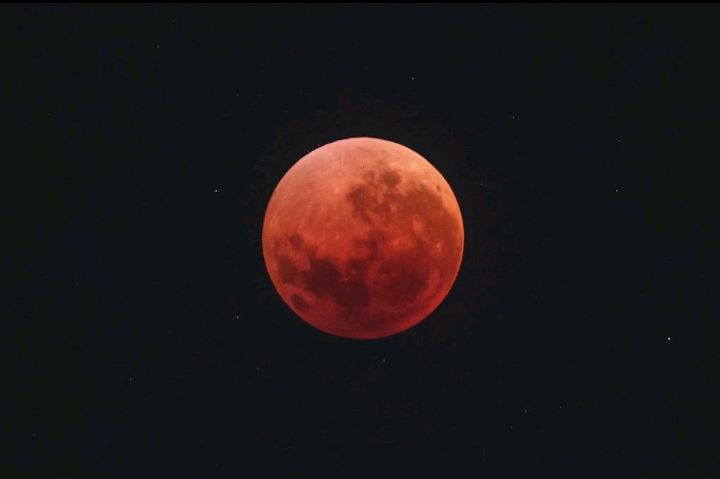
The “Blood Moon” Total Lunar Eclipse of September 7-8, 2025
Natalie Nyathi
Last night, stargazers across the globe were treated to a breathtaking celestial event: a total lunar eclipse, also known as a “Blood Moon.” This stunning phenomenon, visible to an estimated 85% of the world’s population, captivated millions as the Moon passed through Earth’s shadow, transforming into a mesmerizing rusty red orb.
A lunar eclipse occurs when the Sun, Earth, and Moon align in a straight line, with the Earth positioned between the Sun and Moon. As the Moon passes into the Earth’s shadow, it darkens, creating the eclipse. Unlike solar eclipses, which require special eye protection, lunar eclipses are perfectly safe to view with the naked eye.
During a total lunar eclipse, the Moon often takes on a reddish hue, earning it the nickname “Blood Moon.” This striking color is a result of sunlight being refracted and scattered by the Earth’s atmosphere. Shorter wavelengths of light, such as blue, are dispersed, while longer wavelengths, like red, are bent and filtered through the atmosphere, eventually reaching the Moon’s surface. This effect is similar to what causes sunsets and sunrises to appear red. The more dust or clouds in Earth’s atmosphere, the deeper and more intense the red color appears.
The total lunar eclipse of September 7-8, 2025, was widely visible across Asia, Australia, Africa, and Europe. Skywatchers in Asia and Australia enjoyed prime viewing conditions, with the Moon positioned high in the sky during totality. In Europe and Africa, the eclipse was visible as the Moon rose, offering a stunning view along the horizon. Unfortunately, the eclipse was not visible in the Americas.
The eclipse reached its maximum phase at 5:11 pm EDT on September 7th, with the total phase lasting for a remarkable 82 minutes. This was the longest total lunar eclipse since 2022.
To witness the “Blood Moon,” all that was needed was clear skies and an unobstructed view of the horizon. While no special equipment was required, binoculars or a telescope could enhance the viewing experience, revealing more details of the lunar surface. For those in urban areas, finding a high vantage point away from city lights was recommended.
Adding to the spectacle, this lunar eclipse occurred just 2.7 days before the Moon reached perigee, its closest point to Earth in its orbit. This proximity made the Moon appear slightly larger than usual, enhancing the visual impact of the eclipse.
For those who missed this celestial event, mark your calendars! Another total lunar eclipse is expected on March 3, 2026, followed by a partial lunar eclipse on August 28, 2026. Additionally, a total solar eclipse will occur on August 12, 2026, primarily visible in Spain and Iceland.
The “Blood Moon” total lunar eclipse of September 7-8, 2025, served as a stunning reminder of the beauty and wonder of our solar system, captivating millions of skywatchers around the world.