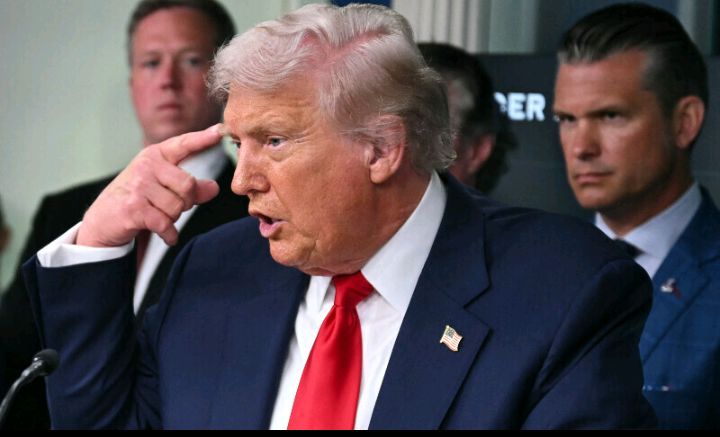
Trump Takes Control of D.C. Police, Deploys National Guard in Crime Crackdown
Natalie Nyathi
In a dramatic move, President Donald Trump has announced the federal takeover of Washington D.C.’s Metropolitan Police Department and the deployment of the National Guard to the nation’s capital, citing a public safety emergency and vowing to crack down on crime and homelessness. This decision, made over the objections of local leaders, marks an extraordinary assertion of federal power and raises questions about the role of the military in domestic law enforcement.
Trump declared it was liberation day in D.C. and invoked Section 740 of the District of Columbia Home Rule Act, a 1973 law that grants the president authority to commandeer the MPD in conditions of an emergency nature. He stated that Attorney General Pam Bondi would immediately take control of the department. The Home Rule Act, while granting D.C. residents the right to elect a mayor and city council, also reserves significant oversight powers for Congress and the President.
Under the Home Rule Act, the President can control the police department for up to 48 hours, but can extend the emergency takeover for a total of 30 days if he notifies members of Congress who oversee D.C. affairs. Any request of more than 30 days must be passed into law.
In addition to federalizing the police force, Trump announced the deployment of 800 National Guard troops to help re-establish law, order and public safety in Washington, D.C. The U.S. Army stated that between 100 and 200 of these troops would be actively supporting law enforcement at any given time, carrying out tasks such as administrative, logistics and physical presence in support of law enforcement.
Trump has repeatedly characterized Washington, D.C., as a city overrun by crime, violence, and homelessness. He has claimed that the city has been overtaken by violent gangs and bloodthirsty criminals and that it is one of the most dangerous cities anywhere in the world.
However, these claims are disputed by local officials and crime statistics. Mayor Muriel Bowser has rejected the president’s claims about crime, stating that the city is not experiencing a crime spike. Data from the city’s Metropolitan Police Department indicates that violent crime in D.C. has been on the decline since 2023. As of August 11, 2025, MPD reported a 26 percent decrease in total violent crime compared to the same time last year. Homicides have also decreased, with 99 reported so far this year compared to 112 in 2024.
Despite these statistics, some argue that the perception of crime often outweighs the statistical reality. A former employee of the Department of Government Efficiency was recently attacked in the city, an incident Trump cited as evidence of the need for federal intervention.
Mayor Muriel Bowser has called Trump’s actions unsettling and unprecedented. While stating that the city would comply with the president’s order, she also expressed concern about the National Guard enforcing local laws. Bowser acknowledged a crime spike post-Covid but said the city worked quickly to put laws in place that got violent offenders off the streets and gave police officers more tools. She also stated that the city has asked for all law enforcement officers acting in Washington to wear identifying clothing so that residents don’t feel any confusion.
Trump has also vowed to address homelessness in Washington, D.C., stating that he would remove homeless encampments and send homeless people elsewhere. He did not provide details on where homeless people would be moved. Local groups working with homeless people have criticized this approach, arguing that it is not a long-term solution and would only transfer the problem to other communities.
Trump’s actions have raised legal and political questions about the extent of presidential power over the District of Columbia. The District of Columbia operates under the Home Rule Act, which gives Congress ultimate authority but allows residents to elect a mayor and city council. Trump’s invocation of the Home Rule Act to justify the federal takeover of the police force is being challenged as unprecedented, unnecessary and unlawful.
Critics have dismissed the move as a short-term publicity stunt and an attempt to trample on the rights of D.C. residents. The Democratic Mayors Association released a statement denouncing Trump’s actions, arguing that crime is down in most major cities, including Washington, D.C., and that the president is creating a political charade to serve his own interests.
The federal takeover of the D.C. police and the deployment of the National Guard are expected to last for 30 days, unless Congress authorizes an extension. It remains to be seen how these actions will impact crime rates and public safety in the nation’s capital, and what long-term effects they will have on the relationship between the federal government and the District of Columbia.